



Morocco is entering a cycle where ideas are no longer enough
In 2026, Morocco presents business leaders with a striking paradox. Macroeconomic signals are positive, major infrastructure projects are accelerating, the green transition is becoming more concrete, digital policy is gaining speed and international institutions are openly pointing to a new wave of private investment potential. Yet many projects still get stuck before execution: incomplete business models, weak financial cases, unclear governance, scattered data, slow permitting or a value proposition that is not sharp enough.
This is where the real challenge begins. The issue is not simply to identify an opportunity. The issue is to make it bankable. In practical terms, a bankable project can prove that it creates value, attracts partners, convinces funders, manages operational risks and delivers measurable outcomes. For Moroccan SMEs, family businesses, industrial groups, exporters, investors and public-private initiatives, that discipline is becoming a competitive advantage.
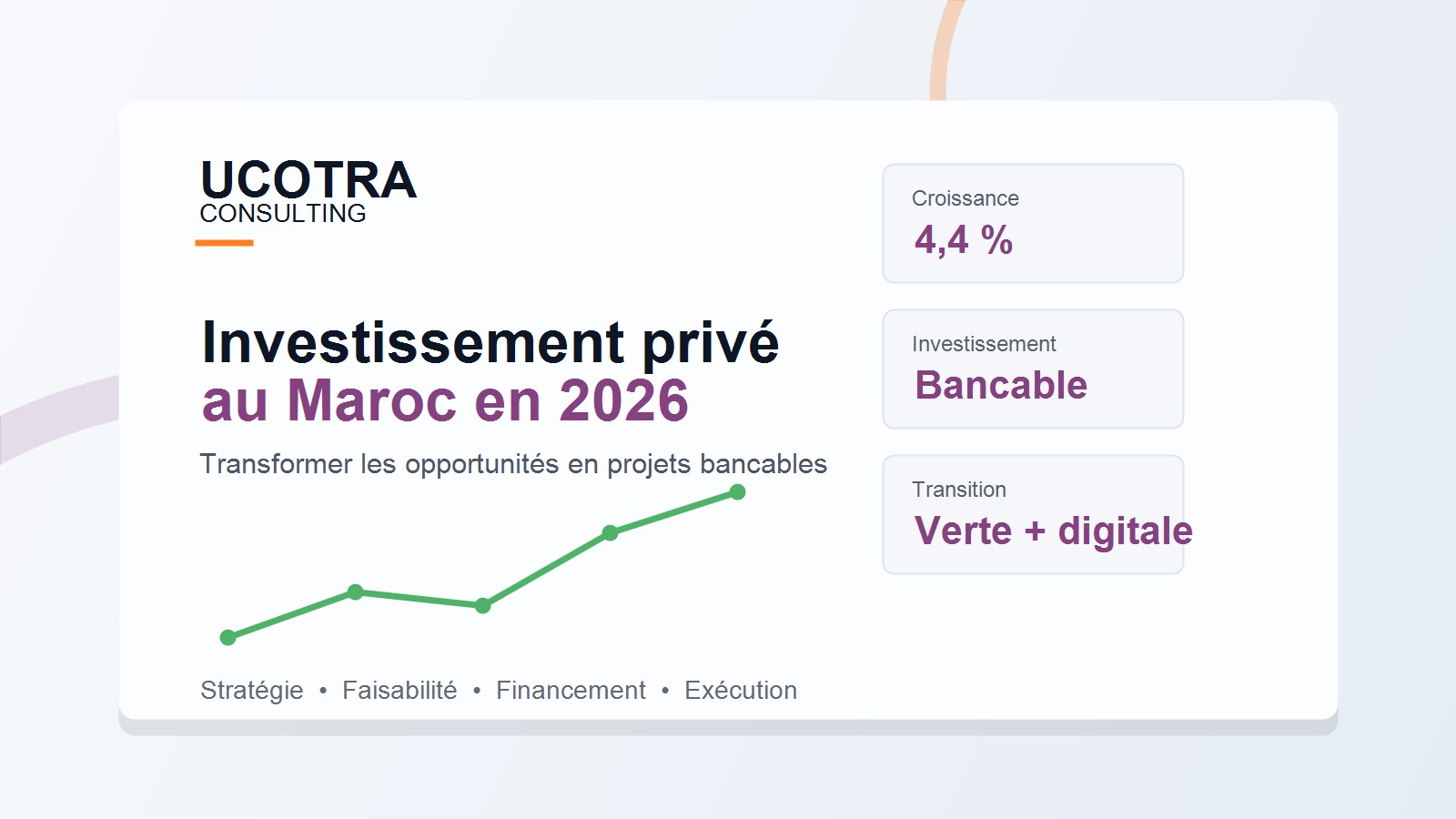
Recent data confirms the shift. The IMF projects Morocco’s real GDP growth at 4.4% in 2026 and 4.5% in 2027, supported by infrastructure investment and greater private sector participation. The OECD is slightly more cautious, projecting 4.2% growth in 2026, but also highlights the role of investment linked to major events. The World Bank estimates that structural reforms could generate 1.7 million additional jobs by 2035 and lift real GDP close to 20% above baseline. These numbers are not a guarantee. They describe a field of opportunity.
What business leaders should read behind the numbers
Growth is solid, but more selective
Morocco’s growth does not automatically benefit every company. The firms that capture the cycle are those able to translate national trends into concrete decisions: which markets to target, which capabilities to build, which technologies to adopt, which skills to reinforce and which risks to control. In a more competitive environment, growth rewards projects that are clear, structured and able to prove traction quickly.
For executives, this means moving from an opportunity mindset to a portfolio mindset. A solar project, an industrial extension, a digital platform, a processing unit, an energy-efficiency program or an export strategy should be assessed through the same questions: market potential, profitability, dependencies, timelines, regulatory risks, financing needs and internal execution capacity.
The private sector is at the center of the next cycle
The World Bank and IFC diagnostic is direct: Morocco has sector assets and policy ambition, but private investment remains below potential. Opportunities identified in decentralized solar power, low-carbon textiles, argan-based cosmetics and marine aquaculture could mobilize around US$7.4 billion in private investment and create more than 166,000 jobs over five to ten years, provided constraints around regulation, land, energy access, administration and skills are addressed.
This lesson matters beyond the four sectors mentioned. Value is often found at the interfaces: between strategy and regulation, energy and industry, standards and market access, innovation and financing. Companies that can build those bridges will move faster than those that treat every issue in isolation.
The green transition is becoming a competitiveness issue
The World Bank’s US$500 million financing package for Morocco’s jobs and green growth agenda illustrates a clear direction: public policy increasingly connects employment, SMEs, clean energy, energy efficiency and export-oriented industries. A green project is no longer only a reputation project. It can be a cost, productivity, resilience and market-access project.
For Moroccan businesses, the questions are concrete: can we reduce energy costs, secure supply, improve customer compliance, document product footprint, access guarantees or financing, and strengthen export competitiveness? These questions should be answered in one integrated investment case, not in separate silos.
The bankable project: a new investment language
A bankable project is not simply a good idea. It is a project that meets six expectations: verified market demand, a clear value proposition, a robust business model, credible execution, readable governance and a defendable financial scenario. This logic applies to industry, services, digital, energy, agribusiness, tourism, healthcare and infrastructure.
1. Documented market demand
The first mistake is to confuse intuition with real demand. A market may be promising at national level and still be difficult for a specific project. Analysis must therefore go down to the right level: customer segments, accessible volumes, distribution channels, acceptable pricing, competition, logistics constraints, regulation and adoption pace. This is the role of a strong market and feasibility study.
2. A strategy that partners can understand
Funders and partners do not only read spreadsheets. They assess the overall coherence: why this project, why now, why this team, why this market and why this execution model. A clear corporate strategy gives the project a backbone and reduces ambiguity.
3. A financial model that tells a credible story
A business plan should not be an optimistic stack of numbers. It should explain how the project makes money, where margins come from, which assumptions are sensitive, which costs may drift, which revenues are recurring, how much cash is required and which indicators trigger decisions. In that sense, transactions, grants and structured finance are strategic topics, not administrative steps at the end of the process.
4. Realistic operational execution
Many projects fail less because of the idea than because of execution. Procurement delays, hiring, maintenance, quality, digital transformation, production monitoring, reporting and change management must be anticipated. Operational performance therefore becomes a credibility lever when speaking to investors, banks or industrial partners.
5. Digital and data thinking from day one
Morocco Digital 2030, accelerated in 2026 around administrative reform, the digital economy and digital sovereignty, is also changing expectations. Companies can no longer treat data as a secondary topic. The strongest projects include indicators, systems, cybersecurity, possible automation and useful AI use cases from the beginning. This is the space where data and analytics and IT strategy and digital transformation become central.
Sectors to watch closely in 2026
It would be irresponsible to suggest that every sector will move at the same speed. But several areas deserve close attention because they combine macro momentum, investment needs, productivity potential and public-policy alignment.
Energy, efficiency and decarbonization
Projects linked to clean energy, energy efficiency, decentralized solar power, consumption audits and industrial loss reduction offer a double benefit: they can lower costs and improve resilience. They may also support export competitiveness and respond to rising international buyer expectations. UCOTRA has already published a dedicated analysis on industrial decarbonization in Morocco.
Export industries and upgrading
Low-carbon textiles, export-oriented pharmaceuticals, agribusiness, natural cosmetics, mechanical industries, aerospace and automotive remain important fields. But competition is increasingly about standards, traceability, quality, speed, product innovation and the ability to document compliance. Companies must invest in their proof system as much as in their equipment.
Digital, AI and productivity
The momentum around GITEX Africa Morocco 2026 and the “AI Made in Morocco” roadmap shows that digital transformation is no longer only an institutional narrative. For companies, the challenge is to select concrete use cases: demand forecasting, predictive maintenance, document automation, commercial analytics, inventory steering, loss detection or customer experience improvement. AI only has value when it improves a real process.
UCOTRA’s method for turning an opportunity into a bankable project
Step 1: frame the ambition
Clarify the main objective: growth, exports, productivity, green transition, digitalization, industrial investment, restructuring or diversification. This prevents every priority from being mixed into one unfocused project.
Step 2: test the market and constraints
Identify real demand, accessible customers, regulatory barriers, land needs, required skills, energy-access conditions, quality expectations and partnership options.
Step 3: build the business case
Translate the opportunity into an economic model: revenue, margins, CAPEX, OPEX, working capital, scenarios, risks and performance indicators. The file should be readable by an executive, a banker, an investor or a public partner.
Step 4: secure financing and partners
Compare options: debt, equity, grants, guarantees, co-financing, industrial partnerships, long-term contracts or phased investment. The best structure is the one that protects execution, not simply the one with the lowest apparent financial cost.
Step 5: manage execution
Set clear governance, milestones, responsibilities, dashboards and correction mechanisms. A bankable project remains fragile if it is not managed rigorously after the investment decision.
Conclusion: 2026 rewards companies that can structure
Morocco in 2026 is not only a growing market. It is a more demanding market. Opportunities are real, but they require more method, better data, stronger financial discipline and greater execution capacity. The companies that win this cycle will be those that can turn a promising idea into a readable, financeable and manageable project.
For leaders, the right question is not simply: “Where is the next opportunity?” The better question is: “Which opportunity can we transform into a bankable project, with the right partners, the right financing and the right execution discipline?” That is precisely where a consulting firm in Morocco such as UCOTRA Consulting can create value.
FAQ - Private investment in Morocco in 2026
Why is private investment in Morocco such an important topic in 2026?
Because growth prospects, infrastructure spending, green transition policies and business-environment reforms place the private sector at the center of Morocco’s next development cycle.
What is a bankable project?
It is a project whose market, business model, risks, governance, financing and execution plan are clear enough to convince partners, banks, investors or institutions.
Which Moroccan sectors offer strong opportunities?
Opportunities depend on location and execution capacity, but clean energy, energy efficiency, export industries, digital, agribusiness, pharmaceuticals, low-carbon textiles and aquaculture stand out in recent analyses.
How can UCOTRA support this type of project?
UCOTRA supports strategic framing, market studies, business cases, financial structuring, operational performance, digital transformation and execution governance.
References and sources
- World Bank: Morocco growth, private investment and jobs, April 2026
- World Bank: jobs and green growth financing, April 2026
- IMF: Morocco 2026 Article IV consultation
- OECD: Morocco economic outlook 2026-2027
- Maroc.ma: acceleration of Morocco Digital 2030, April 2026
- Ministry of Digital Transition: innovation, AI and Digital 2030, 2026